TSN Switch vs. Managed Ethernet Switch: What’s the Difference?
How TSN scheduling, time synchronization, and QoS differ in industrial Ethernet networks
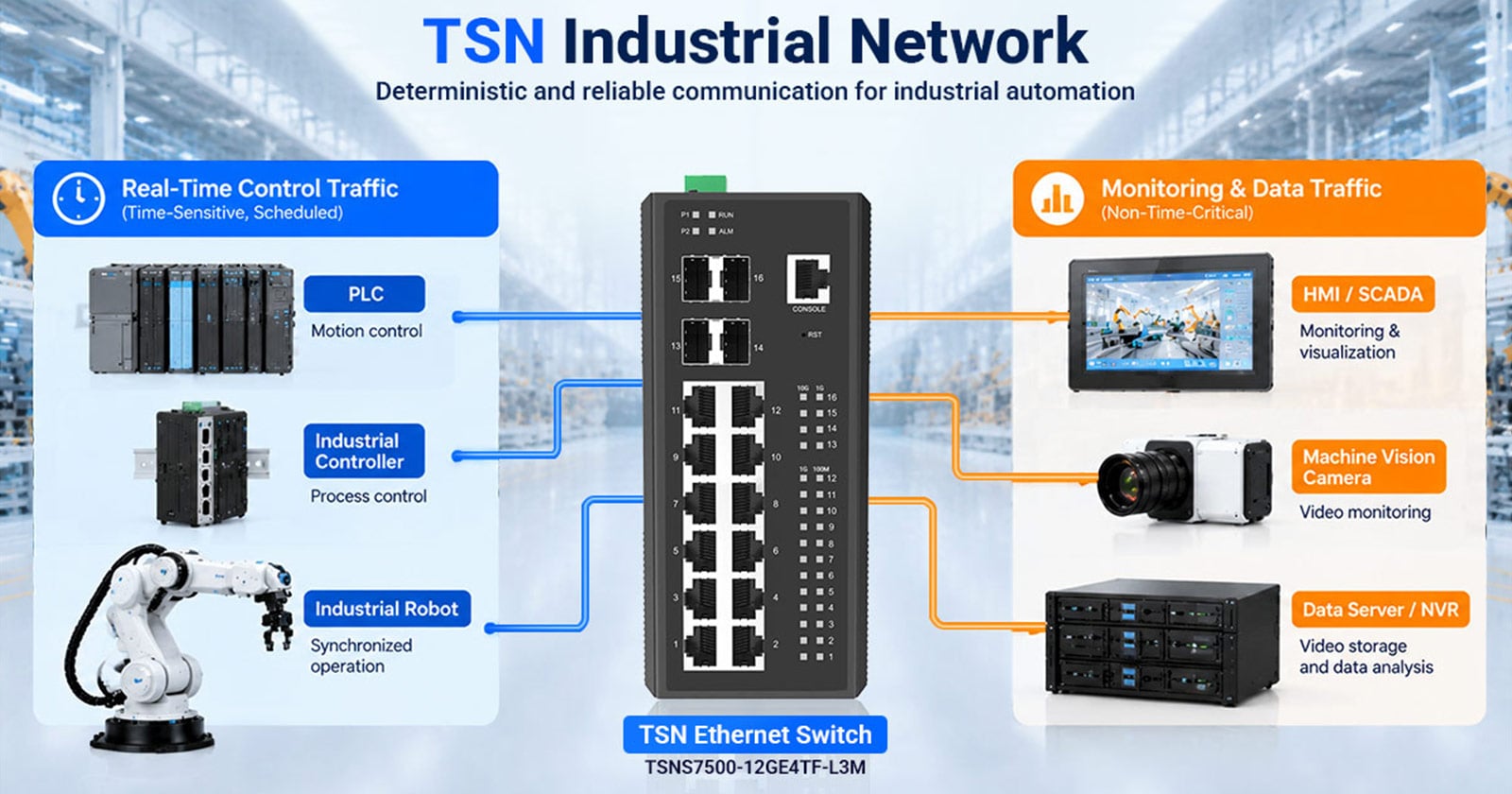
A Time-Sensitive Networking (TSN) switch supports specific IEEE 802.1 mechanisms for time synchronization, scheduled traffic, and other time-sensitive communication requirements. A conventional managed Ethernet switch provides network management features such as VLAN segmentation, Quality of Service (QoS), traffic prioritization, and network monitoring.
The key difference is that a TSN switch can provide time-sensitive networking capabilities beyond conventional network management, depending on its implementation. For industrial automation OEMs, system integrators, and network engineers, understanding these differences helps determine which switch best meets the application's timing, reliability, and connectivity requirements.
A conventional managed Ethernet switch provides tools such as VLAN segmentation, Quality of Service (QoS), monitoring, and traffic control. A Time-Sensitive Networking (TSN) switch can add standardized mechanisms for time synchronization, scheduled transmission, and other time-sensitive communication requirements.
The key difference is that network management and time-sensitive communication solve different problems. Choosing between them starts with understanding what the industrial application actually requires.
Quick Answer: Which Switch Do You Need?
- Choose a managed Ethernet switch when standard Ethernet connectivity, VLANs, QoS, monitoring, and conventional redundancy meet your requirements.
- Evaluate a TSN switch when devices need synchronized communication, scheduled traffic, or other specific TSN mechanisms.
- Check the complete network before making a decision. Endpoints, switch capabilities, configuration, timing sources, and interoperability all affect real-world performance.
TSN is not a replacement for every managed switch. A TSN-capable switch may also support conventional management functions, while a managed switch does not automatically support TSN.
1. What Does a Managed Ethernet Switch Actually Do?
A managed Ethernet switch gives network engineers control over how traffic is classified, forwarded, monitored, and segmented.
Typical capabilities include:
- VLANs: Separate devices or traffic into logical network segments.
- QoS: Classify traffic and assign forwarding priorities.
- Port monitoring: Inspect traffic for troubleshooting and diagnostics.
- Multicast management: Control multicast forwarding where supported.
- Redundancy: Support network recovery mechanisms appropriate to the product.
- Security controls: Apply supported access restrictions and traffic policies.
These features are useful in industrial monitoring, machine connectivity, building automation, and surveillance networks.
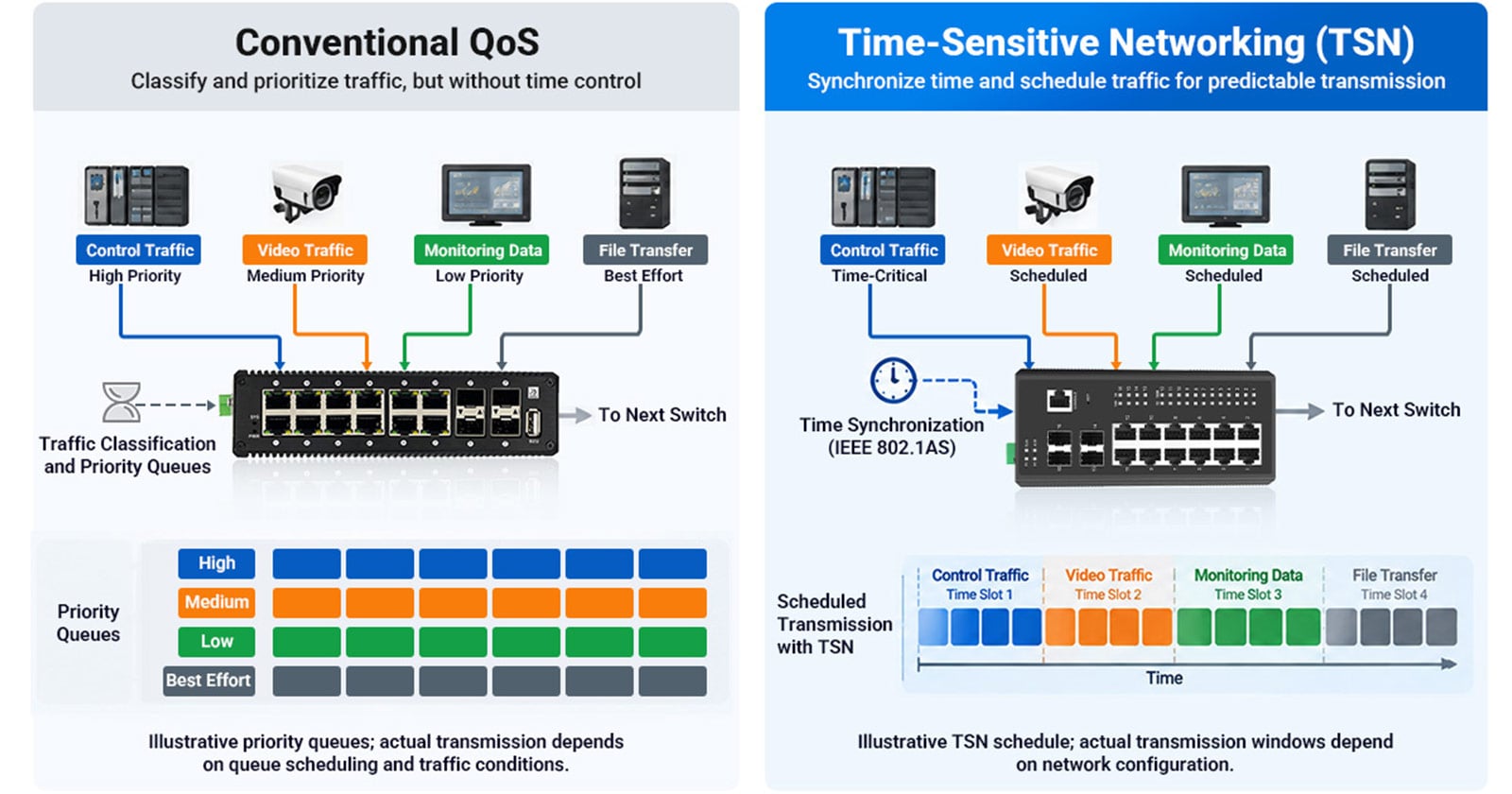
However, prioritizing a packet does not guarantee that it will be transmitted at a predetermined time. When several devices compete for network resources, traffic can still experience queuing and transmission delays.
For applications with strict timing requirements, engineers may need additional mechanisms beyond conventional network management.
2. What Makes a TSN Switch Different?
Time-Sensitive Networking is a family of IEEE 802.1 standards designed to support more predictable communication over Ethernet.
Rather than relying on a single feature, a TSN implementation combines the mechanisms needed by a particular application.
| TSN standard | Main function | Why engineers care |
|---|---|---|
| IEEE 802.1AS | Time synchronization | Helps participating devices maintain a shared understanding of time |
| IEEE 802.1Qbv | Time-aware traffic scheduling | Controls transmission opportunities for scheduled traffic |
| IEEE 802.1Qbu | Frame preemption | Can reduce blocking from longer frames |
| IEEE 802.1CB | Frame replication and elimination | Can improve reliability through redundant frame delivery paths |
Not every TSN switch supports every standard, and implementation details matter. Engineers should verify the specific features, configuration options, and interoperability requirements of the intended network.
A TSN label alone is not sufficient evidence that a product meets a particular application's timing or reliability targets.
3. TSN vs. Managed Ethernet: Practical Comparison
The following comparison focuses on the decisions engineers need to make during network design.
| Design consideration | Managed Ethernet switch | TSN-capable switch |
|---|---|---|
| VLAN segmentation | Commonly available | May be available alongside TSN features |
| Traffic prioritization | QoS and priority queues, depending on model | May combine QoS with TSN mechanisms |
| Shared time reference | Not implied by management features | May support IEEE 802.1AS |
| Scheduled transmission | Standard QoS alone does not provide time-aware scheduling | May support IEEE 802.1Qbv |
| Reduced frame blocking | Must be verified separately | May support IEEE 802.1Qbu |
| Redundant frame delivery | Must be verified separately | May support IEEE 802.1CB |
| Network monitoring | Depends on the product | Depends on the product |
| Industrial temperature rating | Check the datasheet | Check the datasheet |
| Configuration complexity | Depends on features and deployment | May require additional timing and scheduling configuration |
Important: TSN capability and industrial environmental protection are separate considerations. A TSN switch is not automatically rated for extended temperatures, surge exposure, or harsh industrial conditions.
4. Three Industrial Scenarios That Help Determine Your Choice
Scenario A: Machine Monitoring and Data Collection
A factory network collects equipment status, sensor readings, alarms, and production statistics.
If the application can tolerate the latency and variation provided by a properly configured conventional Ethernet network, a managed switch may be sufficient.
Useful capabilities may include VLAN segmentation, QoS, port diagnostics, and suitable redundancy.
Scenario B: Coordinated Motion and Time-Critical Control
Multiple controllers, drives, or other devices must coordinate communication according to defined timing requirements.
In this situation, engineers should determine whether the application requires synchronized clocks, scheduled transmission, or other TSN mechanisms.
A TSN-capable switch may be appropriate when its supported functions are compatible with the endpoints and the complete network design.
The actual timing performance must still be validated under representative traffic and operating conditions.
Scenario C: Mixed Industrial Traffic on a Shared Network
A network carries control messages alongside monitoring data, machine-vision traffic, diagnostics, or other high-volume data.
The challenge is not simply giving one packet a higher priority. Engineers must understand how competing traffic affects transmission timing and whether scheduling or other TSN mechanisms are necessary.
Depending on the requirements, the solution may involve conventional QoS, TSN, network segmentation, additional bandwidth, or a combination of these measures.
5. How to Select the Right Industrial Switch
Before requesting a quotation or comparing product datasheets, work through the following checklist.
1. Define communication requirements
Document the required cycle time, maximum acceptable latency, jitter, synchronization accuracy, and packet-loss tolerance where applicable.
2. Identify required standards
Determine whether the application needs IEEE 802.1AS, IEEE 802.1Qbv, IEEE 802.1Qbu, IEEE 802.1CB, or another specific mechanism.
3. Check port capacity and bandwidth
Count connected devices, determine copper and fiber requirements, and calculate uplink bandwidth based on expected traffic.
4. Verify network compatibility
Check support across switches, controllers, end devices, timing sources, and configuration tools. Interoperability should be validated rather than assumed.
5. Evaluate the industrial environment
Review operating temperature, power inputs, mounting method, electromagnetic compatibility, surge protection, and enclosure requirements.
6. Plan redundancy and recovery
Determine how the network should behave during a link failure, device restart, or other fault. Verify that the selected redundancy mechanisms satisfy the application.
7. Test the complete system
Measure synchronization, traffic scheduling, congestion behavior, recovery time, and application-level performance under realistic conditions.
A switch specification sheet is only one part of the selection process. System-level testing confirms whether the complete design meets the actual requirements.
6. Example: Evaluating a TSN Switch for Industrial Applications
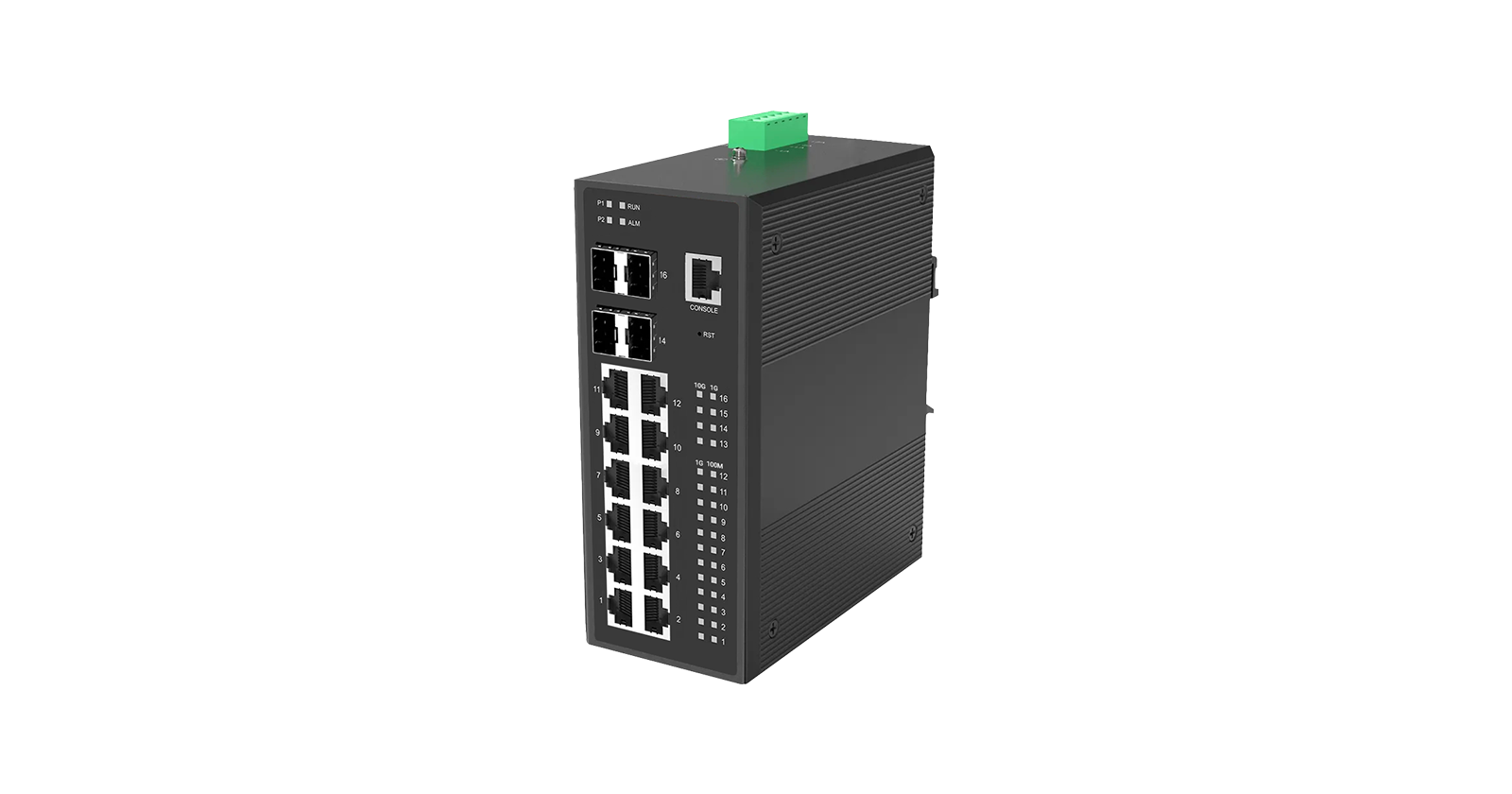
Benchu Group's TSNS7500-12GE4TF-L3M is a 16-port Gigabit TSN switch with four 10G SFP+ uplinks.
It can be considered for industrial network designs that require TSN-related capabilities and higher-speed fiber connectivity. Before selecting it for a specific deployment, engineers should confirm the required TSN standards, supported configuration options, routing requirements, environmental ratings, and compatibility with connected devices.
View the Benchu Group TSN switch and product specifications
For OEMs, system integrators, and networking brands, the selection process should start with the application's technical requirements rather than the product category alone.
7. Frequently Asked Questions
Is every managed Ethernet switch a TSN switch?
No. A managed switch can provide VLANs, QoS, and network monitoring without supporting TSN-specific mechanisms. Verify the exact standards implemented by the product.
Can a TSN switch also provide VLANs and QoS?
Yes. A TSN-capable switch may provide conventional management features alongside TSN functions. The supported feature set depends on the model.
Does QoS guarantee deterministic communication?
No. QoS prioritizes traffic, but priority handling alone does not guarantee scheduled transmission or a particular end-to-end latency. The complete network must be designed and validated against the application's requirements.
Does TSN guarantee zero latency or zero packet loss?
No. TSN mechanisms can help achieve defined timing and reliability objectives, but actual performance depends on the implementation, network configuration, topology, traffic, and endpoint behavior.
Do all TSN switches support IEEE 802.1AS and IEEE 802.1Qbv?
No. TSN covers multiple standards, and implementations vary. Check the datasheet and technical documentation for each required function.
Is TSN necessary for every industrial Ethernet network?
No. Many monitoring and data-collection applications can operate effectively with a suitable conventional managed switch. TSN should be evaluated when the application's timing, scheduling, or reliability requirements justify its additional mechanisms.
Conclusion
The decision between a TSN switch and a conventional managed Ethernet switch should be based on measurable application requirements.
A managed switch may be sufficient for network segmentation, traffic prioritization, monitoring, and standard industrial connectivity. A TSN-capable switch is worth evaluating when the application needs specific mechanisms for synchronized time, scheduled traffic, or redundant frame delivery.
Define the required performance, verify the supported standards, and validate the complete network before choosing your switch.
For additional technical information, visit Benchu Group.
About the author
- Benchu Group is a manufacturer of industrial Ethernet switches and fiber networking solutions. We specialize in Industrial PoE and PoE++ switches, TSN Ethernet switches, and Power over Fiber (PoF) technology. We share practical insights on industrial networking, network reliability, fiber connectivity, and high-power PoE deployment.
Comments
Join the discussionNo comments yet. Be the first to comment.